BBQ Thermometer Decision Guide
Wireless vs Instant-Read Thermometers: Which Do You Need?
Choose a wireless leave-in thermometer when you need to watch pit or food temperature over time without opening the cooker. Choose an instant-read thermometer when you need a fast spot check in several places. They do different jobs, and many cooks benefit from both: the wireless unit warns about trends; the instant-read unit confirms the coldest or most tender spot before serving.
In this guide
- The simplest way to choose
- What a wireless leave-in thermometer does well
- What an instant-read thermometer does well
- Accuracy, speed, and calibration are separate questions
- Probe placement prevents more errors than extra features
- Bluetooth, Wi-Fi, and dedicated radio
- A practical two-thermometer workflow
- Features worth evaluating without naming a winner
- Common thermometer mistakes
- Who should buy which type first?
- Frequently asked questions
- Sources
Quick answer
The simplest way to choose
A leave-in wireless thermometer answers a continuous question: what is happening while the lid stays closed? It can track the cooker, the food, or both. An instant-read thermometer answers a point-in-time question: what is the temperature right here, right now? It is moved from place to place, so it is better for mapping a chicken thigh, checking several steaks, or finding the coolest part of a roast.
Do not choose by technology alone. Start with the failure you want to prevent. If dinner is ruined because the pit quietly runs cold, remote alarms matter. If meat is overcooked because one probe sat in a warm pocket, fast multi-point checks matter. If both failures happen, the two tools are complementary rather than redundant.
What a wireless leave-in thermometer does well
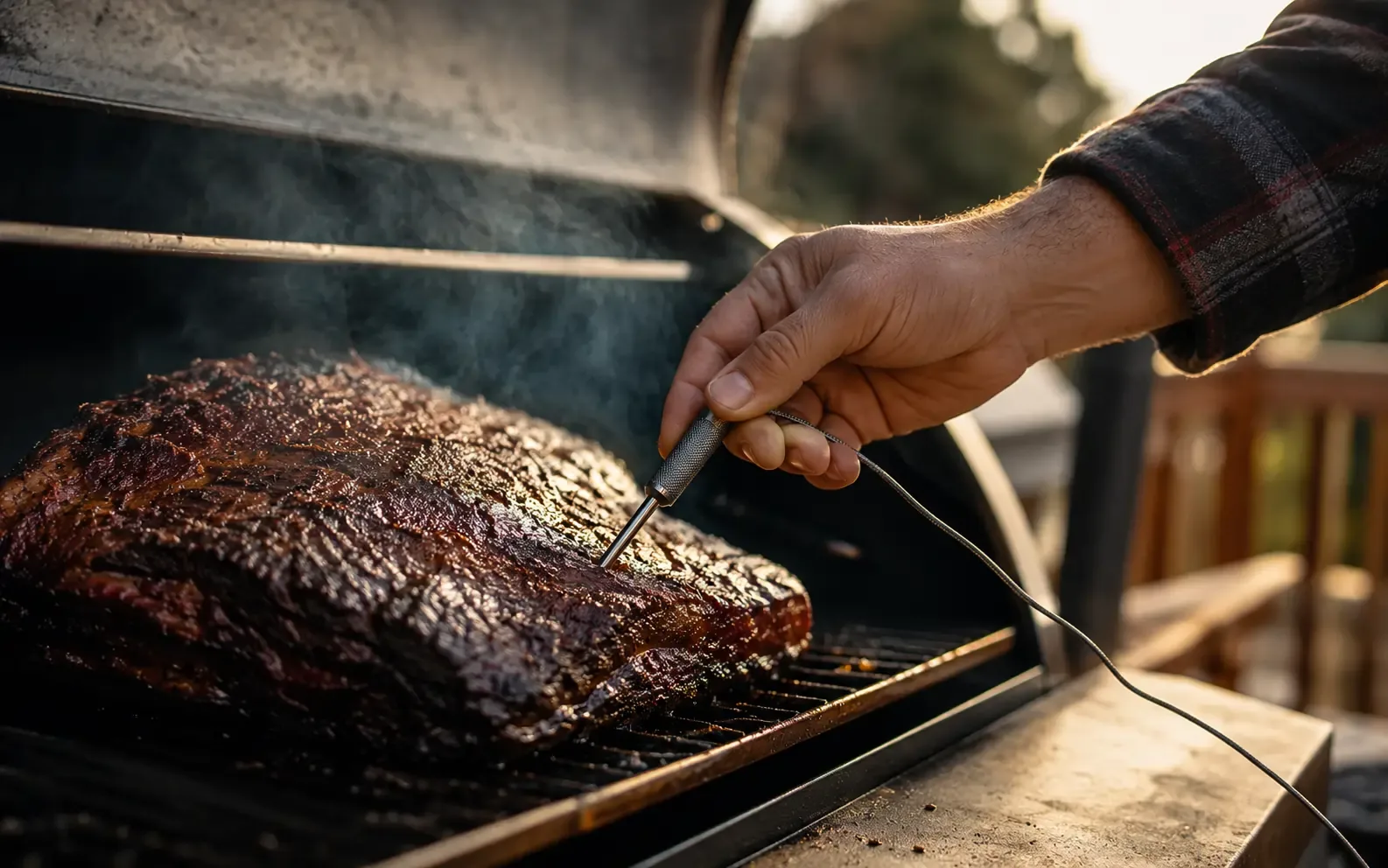
A leave-in probe stays in the food or near the grate during the cook. The transmitter or cooker sends readings to a receiver, phone, or cloud service. Its main advantage is a timeline: you can see a rise, stall, overshoot, or sudden drop and react without lifting the lid for every check. High and low alarms are especially useful on charcoal and offset cookers that need fuel or airflow adjustments.
The tradeoff is dependence on placement, electronics, and connection. A perfectly connected probe can still mislead if its tip touches bone, sits in a fat seam, or hangs over a hot diffuser edge. Wireless range claims also depend on walls, metal, distance, and network conditions. Treat an alarm as a prompt to inspect, not as automatic proof of doneness.
What an instant-read thermometer does well
An instant-read thermometer is designed for short checks, not for remaining in the cooker unless its manual explicitly says otherwise. Insert the sensing area into the thickest portion and move through more than one location. That ability to map a piece of food is its strongest advantage. A single chicken package can contain thighs of different sizes; one roast can have a cooler center and warmer edge.
Fast response matters because the cooker is open while you measure. Even so, the advertised response time is not the whole story. Technique matters: enter from the side when the food is thin, avoid bone, pause long enough for the display to settle, and clean the stem between raw and cooked checks. A quick number from the wrong place is still the wrong answer.
Accuracy, speed, and calibration are separate questions
Accuracy describes how close a reading is to a reference under stated conditions. Resolution describes the smallest displayed increment. Response time describes how quickly the sensor approaches the food temperature. Those specifications are related but not interchangeable. A display showing tenths of a degree is not automatically more accurate, and a fast probe can still be offset.
Check a new thermometer according to its manual and record the result. An ice-point check can reveal a meaningful offset, while boiling-water checks require attention to elevation and atmospheric pressure. Not every consumer probe can be adjusted; some need a documented correction and some need replacement. Repeat a check after a hard drop, unusual reading, water intrusion, or major seasonal use.
Probe placement prevents more errors than extra features
For a leave-in food probe, place the sensing tip in the thickest edible muscle, away from bone and large fat pockets. Confirm the final location from a second angle when the cut shape is irregular. For grate temperature, clip the ambient probe near the food but not touching metal, and keep it away from direct radiant heat or the exhaust stream unless that zone is what you intend to measure.
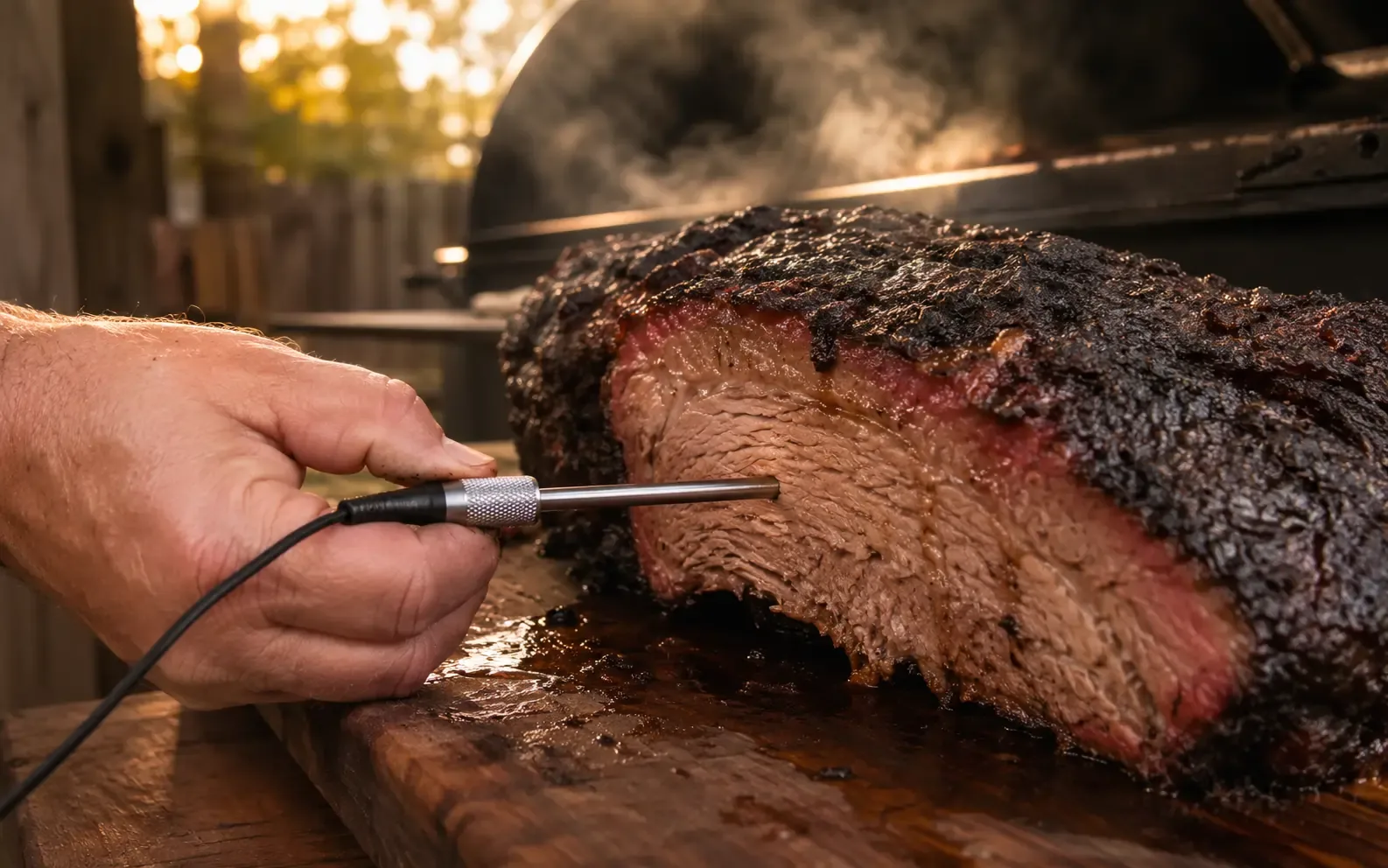
For instant-read checks, sample more than one spot. Push past the center and withdraw slowly to locate the coolest reading in thick food. On thin food, insert from the side so more of the sensing area stays inside the meat. Probe placement is also why a wireless and instant-read pair works well: one gives continuity; the other tests whether the continuous probe represents the whole piece.
Bluetooth, Wi-Fi, and dedicated radio
Bluetooth is convenient at short range and usually pairs directly with a phone, but walls, metal cookers, and distance can interrupt it. Wi-Fi can extend monitoring anywhere the phone has internet access, but setup, router coverage, cloud service, and app support become dependencies. Dedicated radio systems use their own receiver and can be simpler when home networking is unreliable.
A connection loss is not necessarily a temperature failure. Decide what the base unit does when the phone disconnects, whether alarms sound locally, and whether readings continue to be stored. For overnight cooking, test the alarm path while awake. Confirm volume, notification permissions, battery state, and what happens if the internet drops. Convenience features should never be the only layer protecting food or property.
A practical two-thermometer workflow
Before cooking, inspect probe cables and clean the stems. Place a grate probe where the food will sit and a leave-in food probe in the thickest portion. Set conservative alarms as reminders, not fixed finish points. During the cook, watch trends rather than chasing every small oscillation. When the leave-in probe approaches the relevant safety or texture decision, use the instant-read thermometer in several locations.
If the two readings differ, investigate placement before declaring one instrument bad. Move the instant-read probe through the area around the leave-in tip. Check whether the leave-in tip has shifted or contacted bone. If disagreement persists, compare both against a known check procedure after the cook. Record large offsets; memory is a poor calibration log.
Features worth evaluating without naming a winner
For a leave-in system, count usable channels, alarm behavior, local display visibility, replacement-probe availability, cable temperature limits, connection method, battery strategy, and whether the device remains useful if an app disappears. For instant-read units, consider response behavior, sensing-area length, readability, grip with gloves, water resistance, auto-rotate or backlight only if useful, and how easy the stem is to clean.
Read the warranty and manual rather than relying on marketplace labels. Probe cables often have lower limits than the metal probe tip, and open flame can damage them. A higher channel count is useful only if you can place and interpret each probe. Avoid paying for a feature that adds notifications while leaving basic placement and verification unsolved.
Common thermometer mistakes
The first mistake is cooking to an isolated number without asking whether it represents safety, texture, or cooker control. The second is trusting the cooker display without checking the zone beside the food. The third is placing a leave-in probe at the edge of a cut where it reaches the target early. The fourth is leaving an instant-read device inside a hot cooker when it is not rated for that use.
Other common problems include pinching probe cables under lids, immersing connectors, mixing raw-food and cooked-food contact without cleaning, ignoring low batteries, and setting alarms so tightly that normal cycling becomes noise. A thermometer reduces uncertainty only when the user understands what is being measured.
Who should buy which type first?
A beginner using a stable electric or pellet smoker for small foods may get more immediate value from a good instant-read thermometer because multi-point verification is the missing skill. A cook managing charcoal, an offset, overnight roasts, or a cooker known to drift may need a leave-in remote system first. Anyone cooking poultry pieces, steaks, or irregular roasts should still plan a final spot check.
If the budget allows only one tool, choose based on the highest-risk gap in your current process, not on a generic must-have list. Borrow or compare readings when possible, keep the receipt, run the manual’s verification procedure, and learn the sensing area. Tool ownership is not the same as measurement quality.
Frequently asked questions
Can a wireless thermometer replace an instant-read thermometer?
It can monitor one or more fixed points, but it cannot efficiently map many locations. A final instant-read check is useful for finding cooler areas and confirming the leave-in probe’s placement.
Is Bluetooth or Wi-Fi better for a smoker thermometer?
Bluetooth can be simpler at short range; Wi-Fi can provide broader remote access. Walls, metal, router coverage, app support, and local alarm behavior matter more than the label alone.
Are wireless thermometers accurate?
They can be accurate within their stated specification, but the model, probe condition, verification history, and placement determine how useful the reading is. Check the manual and verify suspicious probes.
How many probes do I need?
One grate probe and one food probe cover many long cooks. Extra channels help with multiple cuts or cooker zones only when each reading has a clear decision attached to it.
Where should a meat probe go?
Place the sensing area in the thickest edible muscle, away from bone and major fat seams. For thin foods, insert from the side. Confirm in several spots before serving.
Can I leave an instant-read thermometer in the smoker?
Only if the manufacturer specifically rates that model for continuous high-heat use. Most instant-read bodies are intended for brief checks and can be damaged if left in a cooker.
Why do two thermometers show different temperatures?
They may be in different thermal zones, have different response times, or have placement or calibration offsets. Compare them at the same point and run a proper verification check after the cook.
Do thermometer alarms mean the meat is done?
No. An alarm means the selected point reached a threshold. Confirm food safety with correct placement and official guidance, then assess texture separately when the cut requires it.
Evidence, methodology, and limitations
Evidence status: Research-backed; not hands-on tested
This comparison separates instrument roles using USDA thermometer and safe-temperature guidance, then applies those roles to common smoker workflows. Non-Amazon community pain points—lost connections, confusing probe readings, false confidence in one number, and opening the lid too often—were synthesized without quotations or identities. No model was purchased, timed, calibrated, range-tested, or compared for this article.
Limitations: Response speed, accuracy tolerance, radio range, water resistance, app reliability, and probe durability vary by model. Wireless is used here as an umbrella term for remote-monitoring systems, including dedicated radio, Bluetooth, and Wi-Fi products. This is not a buying ranking, and generated illustrations are not present or treated as evidence.
Sources and review boundary
Official sources govern food safety, fire safety, and manufacturer-specific operation. Community discussions informed the recurring questions addressed here but are not proof that a technique works. Check the manual for your cooker and thermometer before use.