Blackstone brand overview
Blackstone Griddles and Grills: Formats, Surface Care, and Buyer Checks
Choose among Blackstone flat-top griddle formats by fuel, usable surface, grease access, seasoning routine, portability, and support.
Quick answer
Blackstone should be evaluated by exact cooker format and model documentation, not by the brand name alone. First choose the fuel and installation type that fit your routine. Then verify cooking geometry, controls, cleaning access, required clearances, included equipment, manual, parts support, and written warranty terms for the complete model number.
This page is a brand-level decision guide. It does not rank models, report hands-on results, or claim that one format is best for every cook. Current products, specifications, documentation, and support terms can change, so the official US sources linked below are the final check.
Blackstone product families
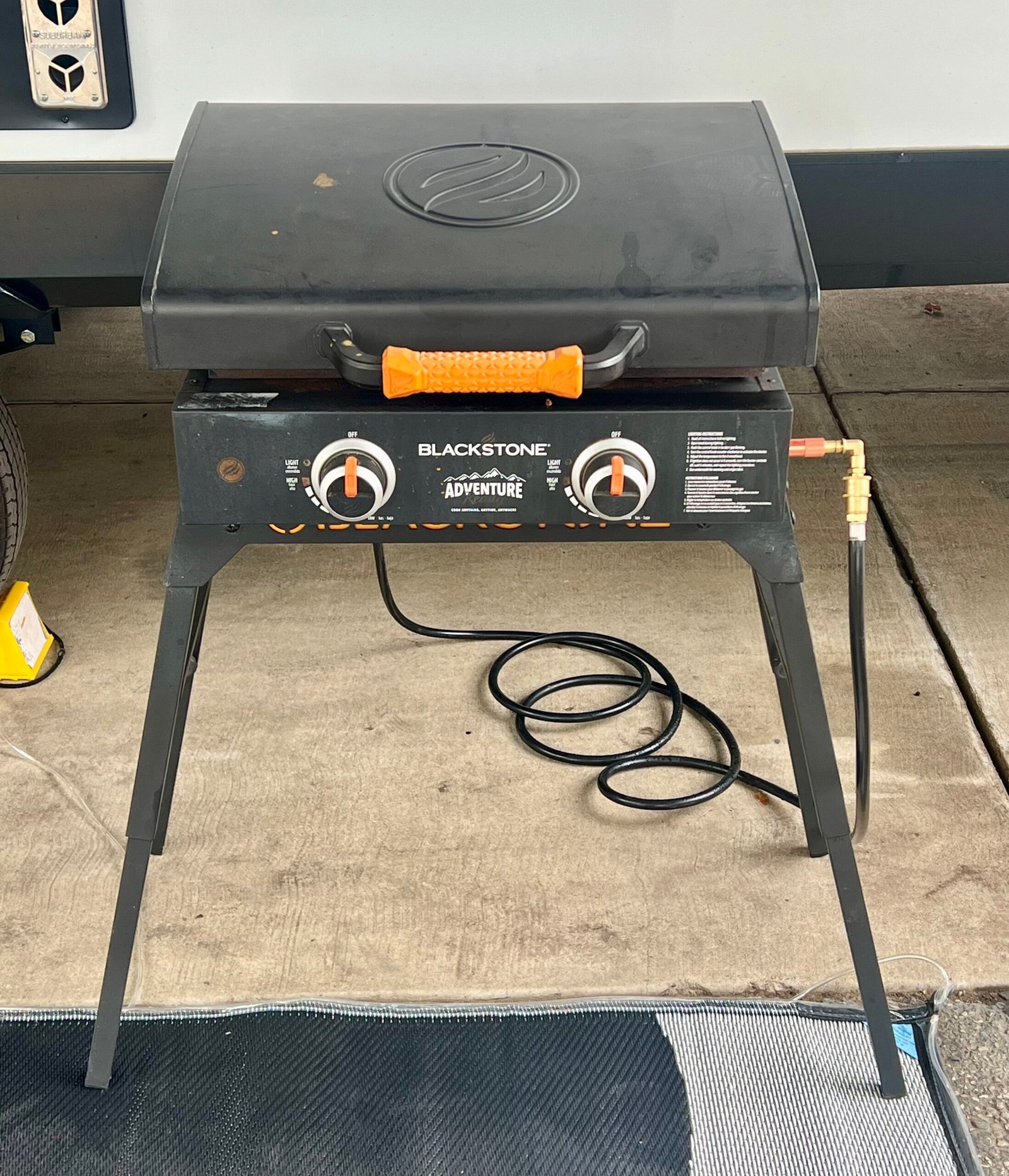
Blackstone is most closely associated with outdoor flat-top griddles. Formats may include tabletop and portable units, cart-style stations, larger cooking platforms, and electric or specialty products. The defining buyer question is often not “Which grill?” but “Which flat cooking surface and support format fits my routine?” Hoods, lids, cabinets, shelves, burner layouts, and grease arrangements vary by exact product.
A flat top handles food on a continuous surface rather than an open grill grate. That changes the way grease, crumbs, sauces, and moisture are managed. It also makes surface dimensions, edge access, grease direction, and the location of the collection cup especially relevant. Confirm each of those details on the specific product and in its manual.
Fuel and cooking approach
Many outdoor griddle formats use propane, while electric formats follow a different heating and power system. Verify fuel or electrical requirements from the exact model label and manual. Do not assume that a propane unit allows natural-gas conversion, that all regulators are interchangeable, or that an electric product is approved for every outdoor outlet and weather condition.
Multiple heat zones can help organize a flat-top workflow, but the number of control knobs does not prove surface uniformity or a specific temperature range. Wind, preheating, food load, surface condition, and burner arrangement can affect results. Use the manufacturer’s lighting, preheating, and shutdown directions, and judge layout by the zones you expect to use.
Cooking surface, footprint, and format
Measure the usable flat surface and the working space around it. You need room for spatulas, raw and cooked food separation, grease collection, lid or hood movement, side shelves, and access to the fuel cylinder or power connection. The published product footprint may not represent the full operating footprint.
Portability should be evaluated as a complete process: weight, handles, legs or stand, removable grease cup, fuel connection, loose accessories, and storage orientation. A tabletop unit still needs a stable, heat-appropriate surface that complies with the manual. For a cart, verify wheel locks and the route between storage and the cooking area before assuming it will move easily.
Controls, maintenance, parts, and support
Flat-top care centers on the cooking surface and grease path. Follow the official steps for initial preparation, routine cleaning, seasoning, drying, and protective storage. Seasoning is an ongoing surface-care process, not a substitute for removing food residue or preventing standing moisture. Avoid adopting a scraper, cleaning chemical, abrasive, or water method unless it is compatible with the manufacturer’s instructions.
Rust prevention depends on cleaning, thorough drying, a maintained protective layer where specified, and protection from weather without trapping moisture. Empty and clean the grease collection system on the schedule appropriate to use. Before purchase, check whether the cup, liner system, hood, hard cover, or soft cover is included or sold separately; inclusions are model-specific.
How to verify warranty and service terms
Do not apply a warranty statement from one Blackstone product to the entire brand. Coverage can differ by model, component, purchase date, region, use, registration status, and other written conditions. Read the current warranty document associated with the exact product before buying. Note the coverage periods by component, exclusions, required maintenance, claim procedure, proof-of-purchase rules, and who pays for labor, shipping, removal, or reinstallation when those topics are addressed.
Also separate warranty coverage from parts availability and dealer service. A part shown in a diagram is not necessarily in stock, and a warranty does not automatically promise local labor. Confirm the support channel, documentation, and service route that apply to your location. Keep the receipt, model and serial record, manual, and installation documents together.
Questions to answer before buying
- How much uninterrupted flat surface does my typical meal need?
- Where does grease exit, and can the collector be removed easily?
- What seasoning and drying routine does the manual require?
- Is a hood, hard cover, soft cover, stand, or shelf included?
- Can the stored unit stay dry without trapping condensation?
- Which official manual and replacement parts match the model number?
Write down the complete model number before comparing offers. Match the fuel type, cooking surface, included stand or cover, grease system, and listed accessories against the exact product page and manual. Two similarly named listings may not describe the same package. Use the rating label, parts records, and current warranty terms to resolve the details; if the retailer and manufacturer disagree, ask the manufacturer or an authorized service channel before buying. This is a documentation check, not a hands-on product recommendation.
Frequently asked questions
Is a Blackstone griddle the same as an open-grate grill?
No. A flat-top griddle cooks on a continuous surface, which changes food contact, grease flow, cleaning, and surface-care requirements.
Do all Blackstone griddles use propane?
No. The brand may include propane, electric, and other product formats. Verify the exact current product specifications and manual.
How do I help prevent rust on a flat-top surface?
Follow the official cleaning, drying, seasoning, and storage instructions. Keep the surface protected from moisture, but do not assume a cover alone prevents condensation or replaces routine care.
Is this a hands-on Blackstone review?
No. We did not cook on, season, measure, rate, or compare individual Blackstone products. This is a research-backed ownership guide.
Evidence and methodology
Evidence status: Research-backed, not hands-on tested. We organized manufacturer catalog, manual, support, parts, and warranty questions around the governed topic for Blackstone. Official product documentation is the authority for current claims. Search-result snippets, retailer copy, and community discussion are not treated as proof of performance, reliability, popularity, or prevalence.
Limitations: We did not assemble, install, ignite, cook on, clean, photograph, measure, or compare a Blackstone unit. We did not verify a current price, inventory level, promotion, model lineup, warranty outcome, or local service availability. The hero image is editorial illustration and is not evidence of our use. Recheck the exact US model documentation and obtain qualified installation help when the manual or local requirements call for it.
Official sources to verify
Accessed for editorial preparation on August 13, 2026. Recheck the current page, exact model manual, rating information, and written terms before making a purchase or installation decision.
Bottom line
The useful comparison is not whether Blackstone is broadly “good.” It is whether a documented product format fits your fuel, space, cooking geometry, cleanup tolerance, storage, service access, and installation constraints. Verify those points against the exact model before committing.