Research-backed backyard BBQ guide
Best Wood for Smoked Salmon: Alder First, Then Mild Fruitwood
This guide explains how smoke intensity, salmon’s delicate flavor, and cooker type affect wood selection for hot-smoked salmon.
Quick navigation
What this guide covers
- Decision checklist
- Define the job: hot-smoked salmon
- Why alder is the baseline
- Apple, maple, and cherry alternatives
- Oak, pecan, hickory, and mesquite
- Pellicle, brine, and smoke adhesion
- Turn a general wood recommendation into your own answer
- Before relying on this guide
- Official safety guidance vs. barbecue texture
- What community questions add—and what they do not
Quick answer
Decision checklist
Concise answer: Alder is the classic restrained starting wood for smoked salmon. Apple, maple, and cherry are approachable alternatives; oak can work in a light dose. Pecan and hickory are stronger, so use them as accents rather than the default for a delicate fillet. Wood species is only part of the result: fuel amount, combustion, pellicle, fillet thickness, brine, and cooker airflow matter just as much.
- Alder: mild baseline with a long association with Pacific Northwest salmon smoking.
- Apple: gentle option for sweet-savory cures.
- Maple: restrained and easy to pair with pepper or herbs.
- Cherry: mild-to-medium and can deepen exterior color; color is not doneness.
- Oak: neutral support wood in a small dose; pecan/hickory: stronger accents.
Define the job: hot-smoked salmon
This guide addresses hot-smoked salmon cooked in a heated smoker to an official safe endpoint. It does not provide a cold-smoking process. Cold smoking keeps fish at much lower temperatures and requires validated controls for curing, time, temperature, sanitation, and pathogens; a backyard flavor guide should not blur those methods. If the goal is shelf-stable, vacuum-packed, or cold-smoked fish, use a tested extension process rather than improvising from a barbecue recipe.
For hot smoking, the useful wood is one that supports the fish without masking it. Salmon is flavorful, but a fillet has a high surface-area-to-mass ratio and may spend less time in smoke than a large roast. Start with a modest dose. It is easier to add slightly more smoke next cook than remove bitterness from this one.
Why alder is the baseline
Alder is repeatedly associated with salmon in Pacific Northwest cooking and is a sensible first reference point because it is generally described as mild. That history does not prove every diner prefers it, and alder from an unknown source is not automatically safe cooking fuel. Buy identified, untreated cooking wood or food-grade pellets and store it dry.
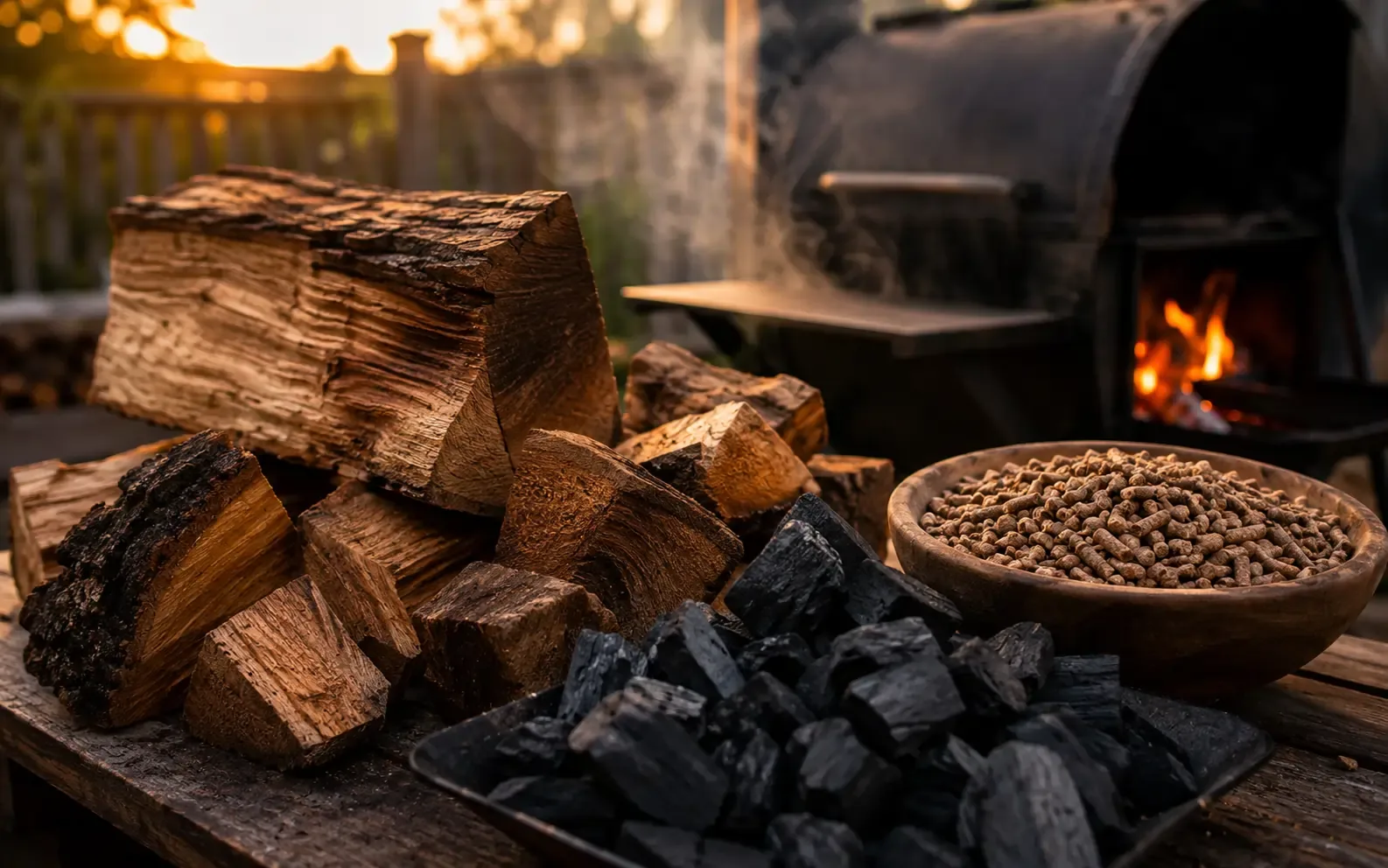
In a charcoal smoker, one modest chunk may be enough for a small fillet, depending on cooker volume and burn. In an offset, alder splits may be difficult to source or manage, so a clean-burning mild hardwood appropriate to the firebox can be more practical. In a pellet grill, read the bag: an “alder” flavor may be a blend. Record the exact product rather than assuming labels from different brands are equivalent.
Apple, maple, and cherry alternatives
Apple works well when a brine or glaze has brown sugar, honey, citrus, or warm spice, but avoid translating “fruitwood” into “sweet smoke” as if sweetness were measured. Maple is another restrained choice and can stay behind pepper, dill, garlic, or mustard. Cherry is commonly used for a richer exterior color and medium fruitwood profile. Surface color still depends on cure, drying, heat, and oxidation, so it should never be used to judge safety.
Choose one species for the first cook. If you blend, keep the recipe and fillet similar and document proportions. A side-by-side tasting with matched pieces would be needed to make a defensible sensory ranking. This article did not conduct one, so the order is a practical starting hierarchy drawn from extension guidance, established culinary usage, and fuel strength—not a claim that one wood won.
Oak, pecan, hickory, and mesquite
Oak can be a clean, neutral support wood, especially when it is the practical fuel for an offset. Use less smoke exposure than you might for beef. Pecan brings a fuller profile; hickory is stronger and is better treated as a small accent. Mesquite is highly assertive and usually a poor beginner default for salmon. None of those woods is “bad” solely because it is strong. The mismatch is dose plus food plus diner preference.
Harsh salmon can result from wet or smoldering fuel, restricted airflow, an overloaded smoke tube, or a fillet left in dirty smoke—not merely the species. Do not soak chunks unless a validated cooker instruction specifically calls for it; delaying combustion can encourage smoldering. Never use softwoods, construction scraps, pallets, painted lumber, driftwood, or wood with uncertain contamination history.
Pellicle, brine, and smoke adhesion
University of Alaska Fairbanks guidance describes drying brined fish until a shiny, tacky pellicle forms before smoking. That prepared surface affects smoke adhesion and moisture loss. Wood cannot compensate for a wet, uneven surface or an over-salted brine. Keep fillet thickness reasonably even, dry it under refrigeration or another controlled safe process, and avoid leaving fish warm while waiting for the surface to dry.
The cure and wood should be planned together. A salty-sweet brine can stand up to alder, apple, or modest maple. Delicate herb seasoning favors restraint. Strong black pepper or a savory glaze may accept light oak. If the thin tail finishes first, shield or portion it; adding smoke to “catch up” only increases exposure on the part already done.
Turn a general wood recommendation into your own answer
Run a small comparison before calling any wood your winner. Use matched portions from the same package, the same salt or brine, the same surface-drying time, and the same cooker position. Change only the wood species or blend. Weigh or count the fuel consistently, note whether it is pellets, chunks, chips, or splits, and record the label exactly. If two samples cannot cook at the same time without sharing smoke, use repeat cooks and disclose that weather and fuel cycles were not identical.
Judge the samples after the same rest and at the same serving temperature. Use a simple rubric: smoke intensity, harshness, whether the meat or fish remains recognizable, fit with the seasoning, and overall preference. Identify how many people tasted and whether they knew which sample was which. A two-person backyard tasting can guide the next family cook, but it is not a universal ranking. Keep the losing result and limitations in the notes rather than rewriting the experiment as a clean success.
Also log combustion. Record cooker, setpoint and grate temperature, ambient conditions, fuel age and storage, exhaust behavior, and when smoke was added. If one sample receives dirty smoke, the comparison is about combustion as much as species. Repeat the useful pair before making a strong public claim. Until those records exist, this guide deliberately uses “starting point,” “mild,” and “stronger” rather than “tested best.”
Before relying on this guide
Confirm the variables this research cannot see. Read the manual for the exact cooker and accessory, inspect the food label and cut, verify that fuel is intended for cooking, and check the thermometer before the cook. Build extra schedule margin so a late finish does not force a higher temperature, premature pull, unsafe hold, or skipped rest. Keep raw-food tools separate from serving tools and prepare a clean tray before the food leaves the cooker.
During the cook, treat a surprising smell, error code, flameout, grease fire, prolonged temperature loss, or uncertain food handling as a stop-and-assess event—not content for a clever workaround. Manufacturer instructions govern the appliance; current official guidance governs safety. This article can organize decisions, but it cannot inspect your equipment or food.
For editorial release, a human reviewer should verify the official source on the review date, identify who takes responsibility for the article, and add only real evidence. If a cook log is later added, it must name the cooker, fuel, food, conditions, measurements, result, and limitations. Keep this research label unless that complete evidence record is reviewed. An attractive illustration or a successful-looking final photo does not upgrade the evidence level.
Official safety guidance vs. barbecue texture
Official safety: USDA lists 145°F for fish. That is the official minimum cited here; lower chef-preference targets are not presented as equivalent safety guidance. Use a clean thermometer in the thickest section. This article covers hot smoking only and does not validate cold-smoking, curing, vacuum-packing, or shelf-stability procedures.
Texture and preference: Texture cues, smoke strength, bark, flaking, and tenderness are quality decisions. They do not replace an official safe minimum, clean handling, or a calibrated thermometer.
What community questions add—and what they do not
Community questions commonly ask whether cedar planks count as smoke wood, whether hickory is automatically too strong, and why a smoke tube made salmon bitter. The useful synthesis is to distinguish plank cooking from combustion fuel, control dose before changing species, and keep supplemental smoke clean. These patterns identify decisions; they do not establish a winning flavor.
Evidence status: Research-backed; not hands-on tested This article synthesizes official safety guidance, extension or manufacturer material where applicable, the governed live-site architecture, and recurring public community questions. No cook, taste test, equipment test, photograph, timing result, or flavor ranking was performed for this draft.
Frequently asked questions
Is alder really the best wood for salmon?
It is the most defensible mild starting point, not a universal taste-test winner. Availability, cooker, cure, and preference can make apple or maple a better fit.
Can I use apple wood for salmon?
Yes. Food-grade apple is a mild option that pairs easily with sweet-savory brines and lighter seasoning.
Is cherry wood good for salmon?
Yes in a restrained dose. It may deepen exterior color, but color is not a food-safety signal.
Can I use hickory?
Yes, sparingly. It is stronger than alder or fruitwood, so use it as an accent and keep combustion clean.
Are cedar planks the same as cedar smoke wood?
No. A food-safe grilling plank is used as a cooking surface under specific instructions; burning resinous cedar as smoke fuel is a different and generally inappropriate practice.
What pellets should I use?
Use food-grade cooking pellets labeled alder, apple, maple, cherry, or a mild blend, and check whether the named species is a blend component.
How much smoke does salmon need?
There is no universal amount. Fillet thickness, surface preparation, cooker, airflow, and fuel form change exposure. Start modestly.
What internal temperature is safe for hot-smoked salmon?
USDA lists 145°F for fish. Measure the thickest part and keep cold-smoking advice separate.
Methodology and limitations
Methodology. We matched this page to one search intent in the approved Master Plan, checked it against the live governed URL inventory, reviewed the project’s non-Amazon audience synthesis, and used primary or official sources for safety and model-boundary claims. Community language was paraphrased at pattern level; no username, quote, or distinctive comment was copied.
Limitations. This is E0 research synthesis, not first-hand evidence. We did not run the procedure, compare woods, log a cooker, measure weather, calibrate a probe, photograph stages, or convene a tasting panel. Cooker model, food thickness, fuel composition, airflow, ambient conditions, and personal texture preference can change the result. Generated editorial art, if later assigned, must be labeled illustration and cannot serve as proof.
Sources
- University of Alaska Fairbanks Cooperative Extension — Smoking Fish at Home (checked 2026-08-01)
- USDA FSIS Safe Temperature Chart (checked 2026-08-01)
Access note: USDA/FSIS pages returned HTTP 403 to the automated research client on 2026-08-01; the official URLs are retained for human safety review before any CMS draft. The University of Alaska Fairbanks fish-smoking source returned HTTP 200 where used. Manufacturer material is model-specific operating guidance, not independent product testing.