Pellet Smoker Guide
Pellet Smoker Temperature Swings: What’s Normal and What to Check
Pellet smoker temperature swings for beginners can look scary at first. You set the grill to 225°F or 250°F, then the display climbs, drops, corrects itself, and makes you wonder if the smoker is broken. Most small swings are normal, but big temperature changes usually come from pellets, airflow, ash buildup, lid openings, weather, probe placement, or startup mistakes.
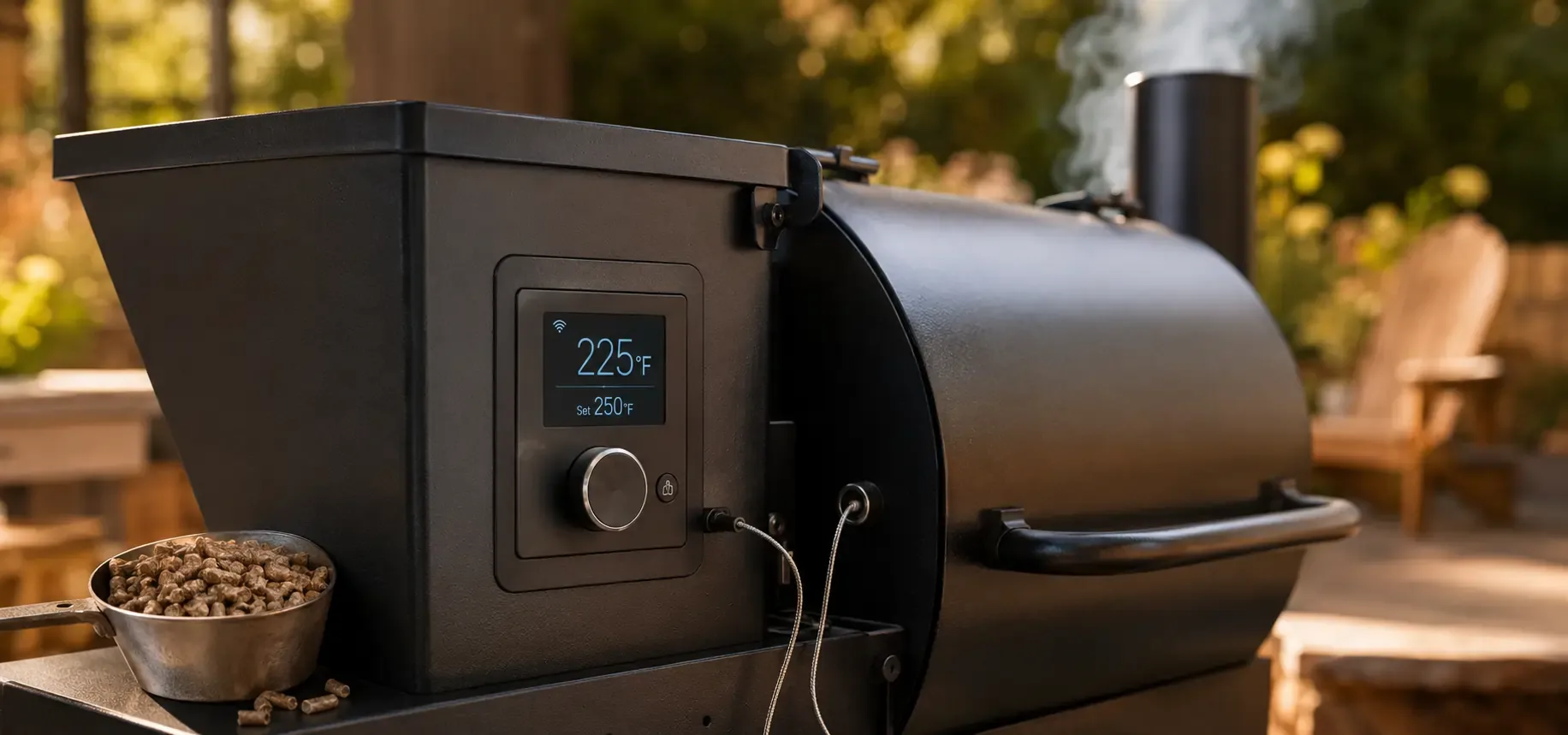
This guide explains what pellet smoker temperature swings are, what range is usually normal, when beginners should worry, and how to stabilize a pellet grill without touching twenty things at once.
Quick navigation
What this pellet smoker temperature guide covers
Quick answer
Are Pellet Smoker Temperature Swings Normal?
Pellet smoker temperature swings can be normal when the reading cycles above and below the set point and then recovers. Treat the pattern as a possible problem when the smoker repeatedly fails to recover after startup, shuts down, flames out, displays an error, or continues drifting during otherwise stable conditions.
Check your model’s manual for its expected behavior. Then inspect the pellets, firepot and airflow, lid and startup procedure, temperature sensor, and weather exposure in that order so you change one variable at a time.
For broader heat-management guidance, see how to control smoker temperature.
Normal vs problem
Are pellet smoker temperature swings normal?
Yes, pellet smoker temperature swings are normal within a reasonable range. A pellet grill works by feeding pellets into a firepot, using a fan, reading temperature, and adjusting the burn. The controller is trying to manage an average cooking temperature, not freeze the display at one perfect number.
For beginners, the important question is not “Did the temperature move?” The better question is “How far did it move, how often did it move, and did the grill recover?”
| Temperature behavior | What it usually means | Beginner response |
|---|---|---|
| Small rise and fall | Normal controller cycling | Keep cooking and watch the average |
| Temporary overshoot after startup | Common during ignition and preheat | Let the grill stabilize before loading food |
| Big repeated swings | Possible pellets, airflow, ash, probe, or weather issue | Start basic troubleshooting |
| Temperature keeps dropping | Possible low pellets, poor fire, ash, or flameout risk | Check fuel, firepot, and airflow safely |
| Temperature runs too hot and will not settle | Possible startup, airflow, probe, grease fire, or controller issue | Follow the grill manual and troubleshoot carefully |
Think in averages. If the grill moves above and below the set point but keeps recovering, that is different from a smoker that keeps climbing, keeps falling, or cannot hold a usable cooking range.
How pellet grills work
Why pellet grills fluctuate more than ovens
Pellet grills fluctuate because they manage a real wood fire with pellets, airflow, a temperature probe, and a controller. The grill feeds pellets, the fire grows, heat rises, the controller adjusts, and the temperature moves again.
A kitchen oven also cycles heat, but you usually do not stare at a live fire controller every few seconds. Pellet smokers show the movement more openly, so beginners notice every change.
Pellet feed cycles
The auger does not feed pellets in a perfectly smooth stream forever. It cycles fuel into the firepot, which can create natural rises and falls.
Fan and airflow changes
The fan helps the fire burn. If airflow changes because of ash, wind, vents, foil, or lid openings, temperature can swing.
Controller corrections
The controller reads temperature and makes adjustments. Sometimes it overshoots or undershoots before settling back down.
Real outdoor conditions
Wind, cold weather, direct sun, and rain can all affect how hard the grill has to work to maintain heat.
Fuel quality
Check pellet quality and sawdust first
If a pellet smoker is not holding temperature, start with the pellets. Poor pellets are one of the easiest problems to miss and one of the easiest to fix.
Good pellets should be dry, firm, and clean. Damp pellets, crumbly pellets, or bags full of sawdust can feed poorly, burn unevenly, and create unstable temperatures.
Good pellets
- Dry and firm
- Break with a clean snap
- Have limited dust in the bag
- Feed smoothly through the hopper
- Are stored in a dry container
Problem pellets
- Damp or swollen
- Soft, crumbly, or dusty
- Stored in humidity
- Full of sawdust at the bottom of the bag
- Feeding unevenly into the auger
Beginner move: empty dusty pellets, vacuum sawdust from the hopper if your manual allows it, refill with dry pellets, and test again before blaming the controller.
Cleaning and airflow
Clean the firepot and improve airflow
Ash buildup can choke the fire and make pellet grill temperature control unstable. If the firepot is dirty, the pellets may not burn cleanly. That can cause weak heat, sudden recovery spikes, dirty smoke, or shutdown problems.
Airflow also matters. Pellet grills need a clear path for heat and smoke. Blocked vents, poor chimney setup, foil over the drip tray, oversized pans, or damaged internal parts can disrupt airflow and create hot spots or swings.
| Area to check | What can go wrong | Beginner fix |
|---|---|---|
| Firepot | Ash blocks clean combustion | Clean when cool and unplugged, following your manual |
| Hopper | Sawdust or damp pellets feed poorly | Empty bad pellets and remove dust safely |
| Drip tray | Foil or liners can block airflow | Keep airflow paths open |
| Chimney or vents | Too much or too little airflow affects heat | Check your manual for proper setup |
| Heat baffle | Damage or bad placement changes heat distribution | Inspect only when cool and contact support if damaged |
Lid control
Stop opening the lid too often
Opening the lid too often is one of the most common beginner mistakes with pellet smoker temperature swings. Every time you open the lid, heat escapes. The controller then tries to recover, sometimes feeding more fuel and overshooting.
This creates a bad cycle: open the lid, lose heat, watch the temperature drop, panic, open it again, then watch the grill overshoot while it recovers.
The old BBQ line is true here: if you are looking, you are not cooking. Use a thermometer, plan your checks, and give the grill time to recover.
Better lid habits for beginners
- Preheat fully before adding food.
- Put food on quickly and close the lid.
- Use a probe thermometer instead of opening constantly.
- Batch your checks instead of peeking every few minutes.
- Give the grill time to recover after opening.
Readings and control
Check probe placement and controller behavior
Not every temperature number means the same thing. The built-in pellet grill probe reads the grill environment from its location. A separate grate probe may read differently because it sits in another part of the cooking chamber.
Beginners often think the grill is broken because the controller temperature, lid thermometer, and third-party grate probe do not match exactly. Some difference is normal because each sensor measures heat from a different place.
Built-in probe
The controller uses the built-in probe to manage the grill. Keep it clean and do not block airflow around it.
Grate probe
A grate probe can show what food sees in one spot, but it may read hotter or cooler than the controller depending on placement.
Lid thermometer
Lid thermometers often read a different zone than the cooking grate. Do not use them as the only judge of pellet grill performance.
Controller learning
Some grills behave differently during startup, after cleaning, in cold weather, or when settings change. Let the grill stabilize before judging it.
Outdoor conditions
Wind, cold, sun, and weather can affect pellet grill temperature
Pellet smokers cook outdoors, so weather matters. Wind can pull heat from the cooking chamber or push air through the grill. Cold weather makes the cooker work harder. Direct sun can heat the metal body and affect readings. Rain and humidity can also create problems if pellets are exposed.
| Condition | Possible effect | Beginner fix |
|---|---|---|
| Wind | Heat loss or airflow disruption | Move the grill to a protected safe location |
| Cold weather | Longer preheat and more fuel use | Allow more time and use proper insulation if recommended |
| Direct sun | Metal body and probe area may heat unevenly | Use shade when safe and practical |
| Rain or humidity | Pellets can absorb moisture | Keep pellets dry and sealed |
Do not use a pellet smoker in unsafe locations. Keep the grill outdoors, ventilated, stable, and away from structures according to the manufacturer’s safety instructions.
Troubleshooting
When pellet smoker temperature swings mean a real problem
Some movement is normal, but not every swing should be ignored. If your pellet smoker cannot recover, shuts down, produces dirty smoke, runs away too hot, or keeps dropping below the cooking range, treat it as a real troubleshooting issue.
Normal enough
The grill rises and falls around the set point, recovers on its own, produces clean smoke, and cooks food predictably.
Needs attention
The grill swings wildly, drops repeatedly, overshoots and stays high, gives errors, or struggles after basic cleaning and fresh pellets.
Check these before calling it broken
- Are the pellets dry and clean?
- Is the hopper free of sawdust buildup?
- Is the firepot clean?
- Is airflow blocked by foil, pans, grease, ash, or vents?
- Was the startup process done correctly?
- Are you opening the lid too often?
- Is wind, cold, rain, or sun affecting the cooker?
- Are you comparing two probes in different locations?
If the grill still behaves badly after basic checks, follow the manual and contact the manufacturer. Do not keep cooking through error codes, flameouts, grease fires, or unsafe behavior.
7-step method
7 easy fixes for pellet smoker temperature swings
Use this simple beginner workflow before making complicated changes or assuming the controller is bad.
- Start with dry pellets. Replace damp, dusty, or crumbly pellets.
- Clean out sawdust. Remove dust from the hopper and feed area if your manual allows it.
- Clean the firepot. Vacuum ash only when the grill is completely cool and unplugged.
- Keep airflow open. Avoid blocking vents, drip tray airflow, chimney space, or heat paths with foil or oversized pans.
- Preheat fully. Let the pellet smoker stabilize before adding food.
- Stop opening the lid constantly. Use probes and planned checks instead of repeated peeking.
- Protect the grill from weather. Reduce wind exposure, keep pellets dry, and allow extra time in cold conditions.
This 7-step method solves many pellet grill temperature fluctuations without replacing parts or chasing every number on the display.
Technical sources
Use manufacturer guidance for pellet grill temperature issues
BackyardBBQGuide.com explains beginner BBQ technique, pellet smoker behavior, airflow, fuel quality, lid control, probe placement, and practical troubleshooting. For model-specific safety, startup, shutdown, cleaning, and repair instructions, always use your pellet grill manual and manufacturer support.
External sources: Traeger Support temperature swings , Pit Boss FAQ , and Bear Mountain BBQ pellet grill temperature fluctuations
FAQ
Pellet smoker temperature swings questions
Are pellet smoker temperature swings normal?
Yes. Pellet smoker temperature swings are normal within a reasonable range because the grill feeds pellets, manages airflow, burns real fuel, and corrects itself around an average cooking temperature.
Why does my pellet grill temperature fluctuate?
A pellet grill temperature can fluctuate because of pellet feed cycles, airflow changes, ash buildup, lid openings, poor pellet quality, weather, probe placement, or controller corrections.
How much pellet grill temperature swing is normal?
Many pellet grills move above and below the set temperature during a cook. Small swings that recover are usually normal. Large swings that keep getting worse should be troubleshot.
Why is my pellet smoker not holding temperature?
A pellet smoker may not hold temperature because of damp pellets, sawdust, ash in the firepot, blocked airflow, frequent lid openings, wind, cold weather, poor startup, or a dirty temperature probe.
Can bad pellets cause temperature swings?
Yes. Damp, dusty, crumbly, or poor-quality pellets can feed unevenly and burn inconsistently, which can cause pellet smoker temperature problems.
Does opening the lid cause pellet grill temperature swings?
Yes. Opening the lid releases heat. The controller then tries to recover, which can cause the temperature to drop first and sometimes overshoot afterward.
Should I trust the pellet grill display or my grate probe?
Both can be useful, but they measure different areas. The controller probe manages the grill from its location, while a grate probe measures one spot near the food. Some difference is normal.
Can wind make a pellet smoker temperature unstable?
Yes. Wind can pull heat from the cooking chamber, disrupt airflow, and make the controller work harder. Move the grill to a safe, protected outdoor location when possible.
When should I contact pellet grill support?
Contact support if the grill still has extreme swings after fresh pellets, cleaning, correct startup, open airflow, and normal weather conditions, or if you see error codes, flameouts, damaged parts, or unsafe behavior.
Related BBQ guides
Build better pellet smoker control.
Pellet smoker temperature swings get easier to manage when you understand fuel quality, airflow, lid control, thermometers, weather, and clean smoke.