Brand comparison guide
Gas Grill Brands: Compare Fuel Configuration, Burners, Format, and Support
Evaluate gas grill brands by propane or natural gas configuration, burner layout, heat zones, grease access, installation, and service documentation.
Quick answer
Choose factory fuel configuration and physical format before comparing features. Then verify burner and grate geometry, control access, grease routing, lid-open space, clearances, installation documents, parts diagrams, and exact written support terms.
Choose the right comparison path
Gas grill brands range from tabletop portables and compact carts to large freestanding cookers and built-in heads. The useful comparison is not which logo appears most often; it is which exact model fits the fuel supply, location, food layout, cleaning routine, and service plan. Similar-looking products may carry different installation or enclosure requirements.
Propane and natural gas are not interchangeable labels. Treat the factory configuration, rating information, regulator or supply requirements, and conversion language as safety-critical model facts. Never infer that a kit exists or that conversion is allowed. Use the manufacturer’s current US instructions and qualified local expertise where the installation requires it.
- Weber — Review gas alongside the manufacturer’s other grill families.
- Napoleon — Check exact gas, built-in, installation, and support documentation.
- Char-Broil — Explore a manufacturer profile spanning gas and other formats.
- Broil King — Compare exact gas and natural-gas model documentation.
- Fire Magic — Focus on built-in and outdoor-kitchen planning without price or superiority claims.
Compare fuel and format
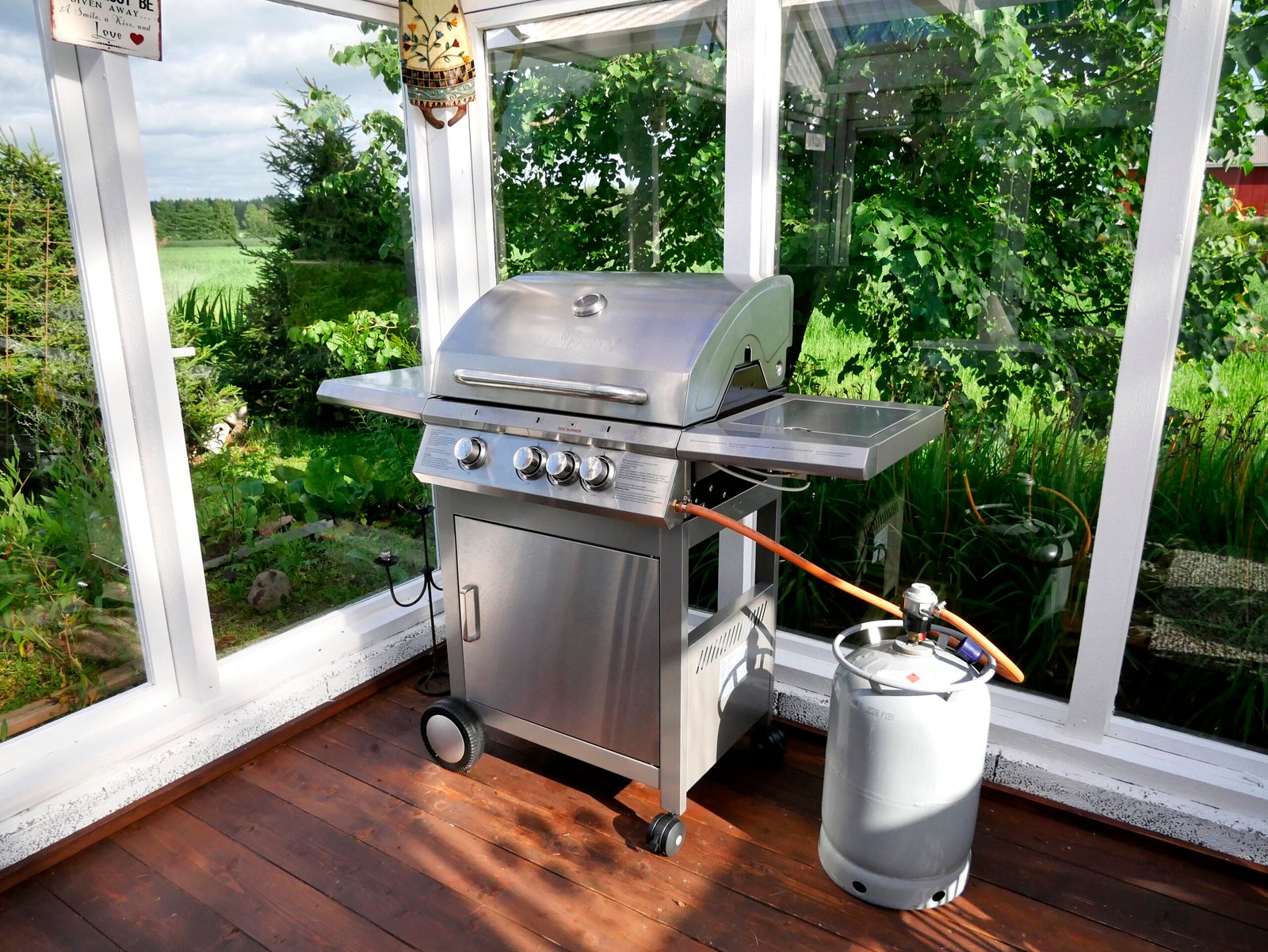
For a propane grill, examine cylinder placement, hose and regulator routing, leak-check instructions, storage rules, and access for changing the cylinder. For natural gas, begin with the exact appliance configuration and installation instructions, then coordinate supply sizing, shutoff, connector, clearances, and code questions with qualified professionals. Do not use burner count or total input alone as a performance verdict.
Burner layout should map to food placement. Record primary-grate width and depth, burner orientation, independent control zones, secondary-rack interference, side components, and lid height. A larger nominal area may not help if the grate shape or control zones do not match the meals. For built-ins, add cutout dimensions, noncombustible requirements, enclosure ventilation, access panels, and lid-open clearance.
Turn the use case into measurements
Write down the normal meal, the largest occasional cook, the tools or pans involved, and the available setup and storage space. Measure the narrowest gate or doorway on the delivery route. For every candidate, record cooking-surface dimensions, overall footprint, open-lid depth, working clearance, fuel or power needs, and the location of grease or ash collection. This converts broad claims into comparable facts.
Controls, cleaning, and ownership
Ignition and control systems deserve a procedural review. Determine the specified startup sequence, how each burner is confirmed, what the manual says when ignition fails, and how shutdown is performed. Side burners, rear burners, rotisserie components, lights, or electrical accessories each add space, fuel, power, cleaning, and service questions.
Grease management is a system, not just a removable cup. Follow the path from grates through heat-distribution components and the cookbox to trays, pans, or channels. Check whether components can be inspected and removed without awkward disassembly. Follow the manual for cleaning products and methods so coatings, burners, ports, sensors, or ignition parts are not damaged.
Also separate included equipment from optional accessories. Confirm the exact model or size each accessory fits, whether it changes clearance or cleaning, and whether the manual recognizes the setup. A family name is not a compatibility guarantee.
Failure points and maintenance
Potential trouble points include obstructed burner ports, damaged ignition components, grease accumulation, deteriorated hoses or connectors, corrosion, unstable carts, and blocked ventilation. This list does not predict model reliability. It helps the buyer inspect maintenance access and locate the manufacturer’s safe troubleshooting and replacement process.
If a grill is built into cabinetry, recovery access matters before the cutout is fabricated. Ask how technicians reach valves, manifolds, electrical components, connections, and grease containers. Preserve the exact installation sheet used for the build; a family-level dimension or retailer summary is not an adequate substitute.
Build a maintenance calendar only from the manual. Record before-use checks, periodic cleaning, seasonal storage, and inspection after unusual operation. If the documentation uses vague intervals, ask support what condition should trigger service. Never bypass a safety device or improvise a fuel, electrical, or structural repair.
Questions to ask manufacturer support
Send questions with the complete model number and country. Save the dated reply with the manual and comparison notes; it provides a better decision record than an uncited claim.
- Is the complete model factory-configured for propane or natural gas, and is conversion expressly permitted or prohibited?
- Which regulator, hose, connector, shutoff, electrical, enclosure, ventilation, and clearance rules apply?
- What are the exact cutout and access requirements for the current model revision?
- How are burners, ports, ignition areas, grease trays, heat components, and the cookbox inspected?
- Which parts require a technician, and how is local authorized service located?
- Which components have distinct warranty terms, exclusions, and claim procedures?
A repeatable verification method
- Confirm the fuel source and factory model configuration first.
- Measure closed and open-lid dimensions, working clearance, and the delivery route.
- For built-ins, reconcile the current installation sheet with the cabinet design before fabrication.
- Map burner zones and grate geometry to the foods and cookware you use.
- Read leak-check, ignition, shutdown, grease, storage, and troubleshooting instructions.
- Verify model and part numbers with official support; keep the written response.
Use a simple pass, fail, or unknown field for each criterion. An unknown should remain open rather than being filled with an assumption. Recheck documents immediately before purchase because lineups and terms can change.
Frequently asked questions
Can every propane grill be converted to natural gas?
No assumption is safe. Conversion may be unavailable or prohibited. Follow only explicit manufacturer instructions for the exact model and use qualified service where required.
Does a higher BTU number mean better grilling?
Not by itself. Input does not prove heat distribution, temperature control, efficiency, or suitability for your food.
What should I check for a built-in gas grill?
Use the exact cutout, enclosure, ventilation, clearance, fuel, electrical, access, and combustible-material instructions before construction.
How many burners do I need?
Choose based on grate geometry and the independent zones your meals require, not burner count alone.
Where should warranty details come from?
From the current written US terms applicable to the exact model, not a summary badge or an assumption about the whole brand.
Evidence and methodology
This page is an editorial comparison framework, not a hands-on test or model review. It makes no rating, price, availability, performance, reliability, or universal-best claim. Manufacturer catalogs help define product families, while current US manuals, assembly or installation guides, parts diagrams, support pages, and written warranty terms govern exact-model facts.
Community comments are anecdotal and are not treated as proof. The collected search-result set was rejected for semantic use and is not cited. Questions and entities here come from the governed topic map: fuel, format, cooking geometry, airflow or burners, controls, power, ash, grease, materials, maintenance, manuals, parts, warranty, and support.
Source box
Verify before relying: the manufacturer’s current US product page for the complete model number; owner’s and assembly manuals; installation or cutout instructions where applicable; official parts diagrams; official troubleshooting and safety notices; and the full written US warranty. Retailer summaries may help locate a product but should not override model-specific manufacturer documents.
Final checklist
Do not choose until the exact model passes the same brief for fuel, format, fit, usable cooking geometry, controls, cleaning access, placement, storage, documentation, parts identification, and service path. Keep unresolved safety or compatibility questions marked as unknown and obtain a written answer before installation or operation.